(559) 325-2597
Garden Bridges, Custom Redwood Garden Bridges - Redwood Garden Bridges
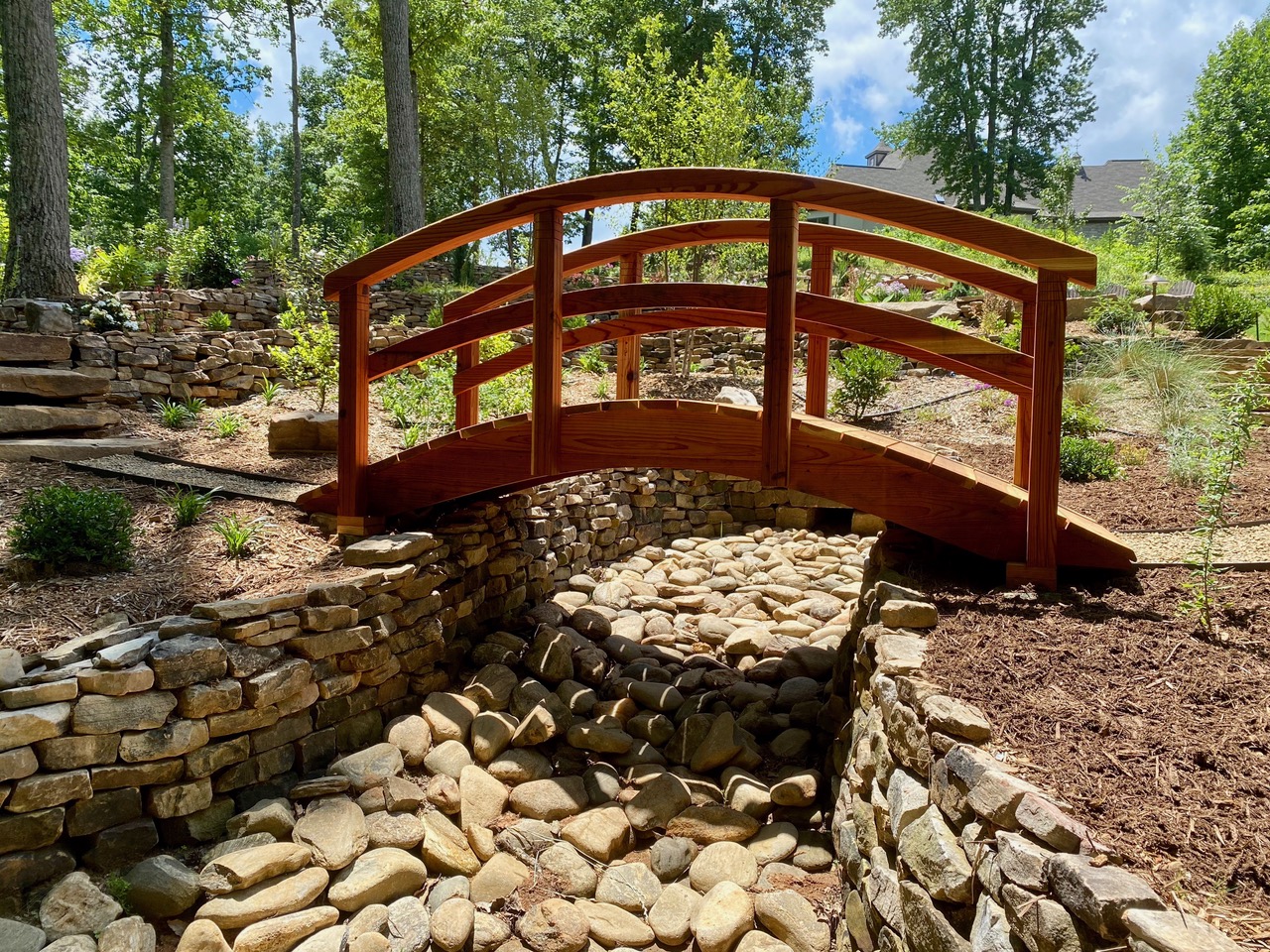
Custom 12-Foot Arched Redwood Garden Bridge in Baldwin City
Published: Sun, 25 Oct 2026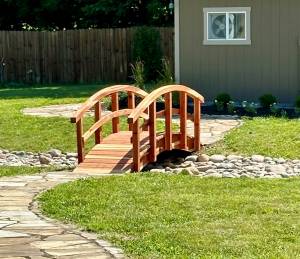
Custom 12-Foot Arched Redwood Garden Bridge in Baldwin City, Kansas – A Unique Backyard Bridge Built to Order
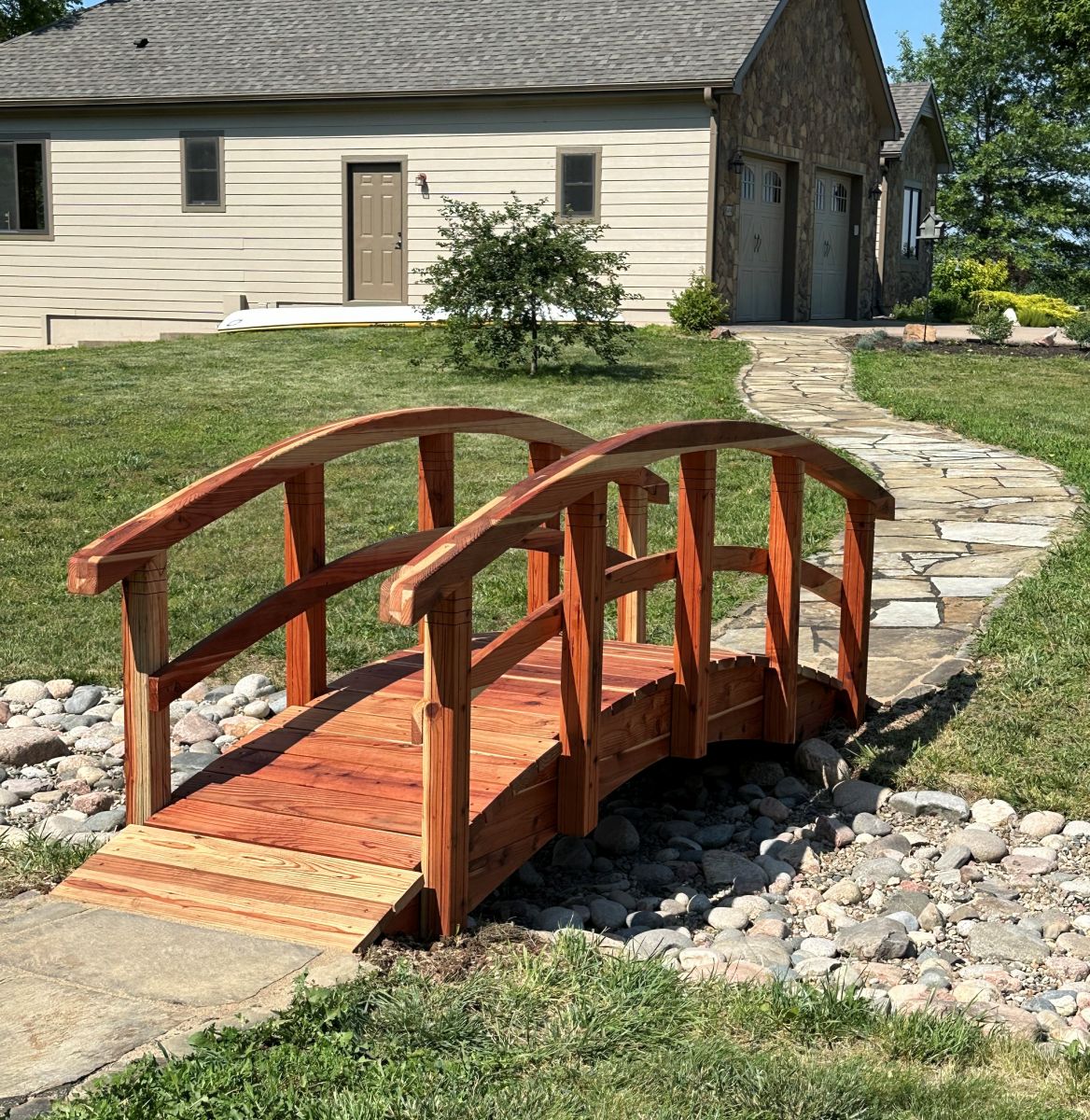
A beautifully designed wooden bridge can completely transform the appearance of a garden, turning an ordinary backyard into a landscape with character, depth, and a distinctive architectural feature. For one homeowner in Baldwin City, Kansas 66006, the vision went far beyond a standard wooden footbridge. The customer wanted a custom-built redwood bridge with an elegant high arch, a wider walking surface, additional railing posts, and a specially designed laminated handrail unlike those found on conventional garden bridges.
The result was a 12-foot-long, 3-foot-8-inch-wide custom arched redwood garden bridge, featuring an 8-inch arch, four posts on each side, a unique three-piece laminated top handrail, and a sealed wood finish. Every major detail reflected the homeowner's individual preferences, from the bridge's curved profile to the precise arrangement of its railings.
This project in Baldwin City demonstrates how a thoughtfully designed garden bridges can combine natural beauty, traditional woodworking, and personalized craftsmanship to create something genuinely distinctive for a residential landscape.
A Custom Redwood Bridge Designed for a Baldwin City Backyard
Baldwin City is located in Douglas County in northeastern Kansas, a region characterized by rolling landscapes, established residential neighborhoods, open countryside, and a mixture of wooded and prairie environments. These surroundings offer numerous opportunities for homeowners who want to incorporate natural materials and decorative wooden structures into their outdoor spaces.
Whether a property features mature shade trees, ornamental flower beds, native grasses, carefully maintained lawns, or a more naturalistic landscape, a wooden bridge can introduce an attractive focal point while connecting different areas of the garden.
For this Baldwin City customer, however, choosing an ordinary bridge was not enough. The homeowner had a specific design in mind and wanted several details that would make the finished structure different from a standard model.
The most important requests included a more pronounced arch to increase ground clearance, an additional railing post on each side, a wider top handrail made from three laminated pieces of redwood, and a center railing positioned flush with the posts.
These elements were brought together in a custom design measuring 12 feet in length and 44 inches in width, with the top railing positioned 30 inches above the walking surface.
Rather than treating the bridge as a simple garden accessory, the project approached it as an individual piece of outdoor woodworking designed to reflect the customer's preferences.
Custom Redwood Garden Bridge Specifications – Baldwin City, KS 66006
The bridge was created around a clearly defined set of dimensions and construction details. Each feature contributes to its distinctive appearance and overall proportions.

| Bridge Feature | Custom Project Details |
|---|---|
| Project Location | Baldwin City, Kansas 66006 |
| County | Douglas County, KS |
| Bridge Type | Custom high-arched redwood garden bridge |
| Wood Material | Natural redwood |
| Overall Length | 12 feet (144 inches) |
| Overall Width | 3 feet 8 inches (44 inches) |
| Arch Rise | 8 inches |
| Railing Posts | 4 posts per side, 8 posts total |
| Top Handrail | Three redwood railing pieces laminated together |
| Top Handrail Placement | Positioned on top of the railing posts |
| Center Railing | Flush with the railing posts |
| Top Railing Height | 30 inches above the walking surface |
| Finish | Sealed redwood |
| Construction Style | Custom-built to the homeowner's specifications |
These specifications illustrate the level of personalization possible with a handcrafted bridge. The homeowner was able to select not only the overall dimensions but also the curvature, railing arrangement, handrail construction, and finishing details.
Why the Customer Requested a Higher 8-Inch Arch
One of the defining features of this Baldwin City project is its 8-inch arch. The customer specifically requested this higher curved profile to provide additional clearance beneath the bridge.
The arch is one of the most visually recognizable characteristics of a traditional wooden garden bridge. Instead of extending horizontally from one end to the other, the bridge rises toward its center, creating an elegant curve that draws attention and adds architectural interest to the surrounding landscape.
With an 8-inch rise, this custom bridge has a more pronounced curved silhouette than a flat walkway or a relatively shallow-arched design.
Additional Ground Clearance
Ground clearance can be an important consideration when a bridge is intended to span uneven terrain, a landscaped depression, a decorative dry creek bed, or another garden feature.
For the Baldwin City customer, increasing the arch was an intentional part of the design. The higher profile was selected to provide more room beneath the structure while preserving the attractive curved appearance of a traditional redwood bridge.
The actual clearance under a bridge depends on its structural dimensions, support locations, and the elevation of the surrounding ground. The 8-inch arch rise describes the bridge's curved profile rather than a guaranteed clearance measurement at every point beneath it.
A More Elegant Side Profile
A high-arched bridge introduces a distinctive shape into a garden landscape. Its curve contrasts naturally with straight pathways, rectangular decks, fences, and other horizontal features commonly found in residential backyards.
From the side, the bridge becomes an architectural element in its own right. From either end, the rising walking surface creates a sense of movement and visual interest.
In a Baldwin City garden surrounded by ornamental plants, mature trees, or natural stone landscaping, this graceful profile can help establish the bridge as a central design feature.
Balancing the Arch With the Bridge's Length
The proportions of an arched bridge depend on the relationship between its length, width, and rise.
For this project, the combination of a 12-foot length and an 8-inch arch creates a noticeably curved structure without turning the bridge into an excessively steep visual feature.
The proportions were selected for the customer's particular design. Other gardens may call for a different arch height depending on their terrain, available space, and intended use.
A Unique Three-Piece Laminated Redwood Handrail
Perhaps the most distinctive woodworking detail of this Baldwin City bridge is its custom laminated top handrail.
The homeowner wanted something wider and more substantial than a conventional wooden railing. Instead of using a single standard rail, the requested design called for three separate redwood railing pieces to be glued together, creating one wider laminated handrail.
This feature gives the upper railing a prominent appearance and sets the bridge apart from more conventional designs.
Three Redwood Pieces Joined Into One Wider Handrail
The custom handrail was created by laminating three individual redwood rail components together.
This arrangement allowed the top rail to have a wider profile than an ordinary single-piece handrail, giving it greater visual presence along the bridge's length.
The width of the upper handrail was an important part of the homeowner's vision. It was not simply a decorative addition selected after the rest of the bridge had been designed.
Instead, the broader railing helped define the overall character of the finished structure.
Positioned Above the Railing Posts
Another unusual aspect of the design is the placement of the laminated handrail.
The customer specifically wanted the wider top rail positioned on top of the railing posts, rather than attached only along their sides.
This arrangement creates a continuous upper visual line, while the vertical posts support the overall appearance of the railing system.
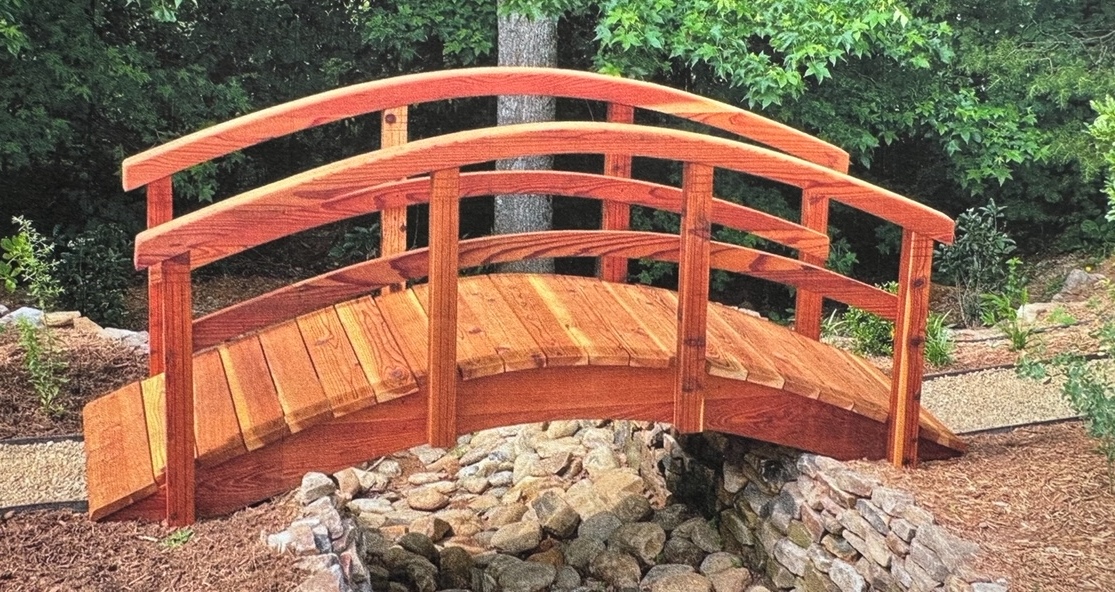
Viewed from the side, the handrail forms a strong horizontal and gently curved design element above the regularly spaced posts.
Combined with the 8-inch bridge arch, this feature gives the structure a distinctive handcrafted character.
A Personalized Alternative to Standard Bridge Railings
Many wooden garden bridges feature relatively simple handrails consisting of a single upper rail and a smaller number of posts.
There is nothing inherently wrong with that approach, but it does not always match the vision of a homeowner looking for a more substantial architectural feature.
The laminated handrail on this Baldwin City project demonstrates how changing one component can significantly influence the appearance of the entire bridge.
By specifying a wider handrail and an unconventional mounting position, the customer created a railing design that was distinctly their own.
Four Posts on Each Side: A Distinctive Eight-Post Railing System
The customer also requested an additional railing post on each side, bringing the total to four posts per side and eight posts across the complete bridge.
Although railing posts are sometimes treated as secondary components, their number, spacing, and relationship to the handrails strongly influence the visual balance of a wooden bridge.
On this 12-foot bridge, the eight-post arrangement creates a repeated pattern of vertical elements along the curved walking surface.
The posts visually connect the upper laminated handrail with the main bridge structure, giving the side railings a more defined appearance.
Why Post Arrangement Matters
A railing with relatively few posts tends to create a more open, minimalist appearance. Increasing the number of posts changes that character, introducing more visible structure and rhythm.
For the Baldwin City project, the customer preferred the appearance of four posts on each side.
This customized arrangement was particularly well suited to the wider laminated handrail, which forms a prominent upper element above the posts.
The result is a bridge with recognizable proportions and railing details that reflect the customer's specific design preferences.
The Center Rail Was Designed Flush With the Posts
The center railing received special attention as well.
The homeowner requested that the center rail sit flush with the railing posts, creating a more integrated side profile.
Rather than allowing this railing component to project prominently beyond the posts, the flush arrangement helps preserve a cleaner relationship between the vertical and horizontal elements.
It also emphasizes the contrast between the center rail and the wider laminated top handrail, which was intentionally placed above the posts.
Although this detail may appear subtle, it contributes to the bridge's distinctive appearance when viewed as a complete structure.
A Top Handrail Positioned 30 Inches Above the Walking Surface
Another precise requirement was the height of the railing.
The customer requested a top handrail positioned 30 inches above the walking surface.
That measurement influenced the proportions of the posts and the overall visual balance of the upper railing system.
On an arched bridge, railing height plays an important part in the relationship between the curved deck and the upper handrail.
A railing should look proportionate to the bridge rather than appearing visually disconnected from its shape.
For this custom design, the 30-inch measurement was selected by the homeowner and incorporated into the requested specifications.
Railing dimensions for other projects should be determined according to the intended use, installation conditions, applicable local requirements, and appropriate safety considerations. The dimensions selected for one private garden bridge are not necessarily suitable for every pedestrian crossing
 .
Why Redwood Is an Attractive Material for Kansas Garden Bridges
Wooden garden structures have an enduring appeal because they blend naturally with outdoor surroundings. Redwood is particularly attractive for custom bridge construction because of its warm coloration, distinctive grain, and suitability for properly designed outdoor woodworking projects.
The material offers an appearance that complements both traditional and contemporary residential landscapes.
Natural Beauty and Warm Wood Tones
Redwood is recognized for its rich reddish-brown coloration and natural wood grain.
These characteristics make it particularly appealing in gardens where organic textures are important to the overall design.
Whether surrounded by ornamental grasses, flowering shrubs, stone pathways, or established trees, redwood can provide a warm visual contrast against green vegetation and natural landscaping materials.
Unlike materials with a highly uniform manufactured appearance, each piece of redwood has its own grain pattern and tonal variations.
That individuality contributes to the appearance of handcrafted outdoor structures.
Dimensional Stability
Redwood is valued for its relatively good dimensional stability, an important characteristic for outdoor wooden construction.
All natural wood responds to changes in moisture and temperature, but selecting appropriate materials and using sound construction methods can help manage these effects.
For a redwood bridge exposed to Kansas weather, suitable installation, drainage, finishing, and maintenance remain essential.
Natural Decay Resistance
Redwood heartwood contains natural compounds that contribute to resistance against decay and certain wood-damaging insects.
This characteristic is one reason redwood has long been appreciated for outdoor woodworking.
However, the resistance of individual boards depends on the lumber grade, proportion of heartwood, environmental exposure, and other factors.
Redwood is not maintenance-free, and a properly designed bridge should avoid unnecessary prolonged moisture exposure wherever possible.
Sealed Redwood for Outdoor Protection
The Baldwin City customer selected a sealed finish for the completed bridge.
Applying an appropriate exterior wood finish can help limit moisture absorption, reduce weathering effects, and preserve the desired appearance of the redwood.
A finish is particularly relevant for outdoor structures exposed to changing seasonal conditions.
In northeastern Kansas, wooden structures experience warm summers, freezing winter temperatures, periods of rainfall, and fluctuating humidity.
These environmental conditions can affect the appearance and condition of exposed wood over time.
Preserving the Appearance of Redwood
Natural redwood changes appearance when exposed to sunlight and weather.
Without suitable protection, its original reddish tones may gradually shift toward a weathered gray appearance.
A compatible exterior finish can help manage these changes, although the final results depend on the type of coating, exposure, and maintenance.
Homeowners who prefer the warmer appearance of freshly finished redwood should inspect the surface regularly and maintain it according to the finish manufacturer's recommendations.
Long-Term Wood Care
Sealing a bridge does not eliminate the need for ongoing maintenance.
Exterior finishes gradually wear, and the walking surface may experience more abrasion than less frequently touched areas.
Regular cleaning, inspections, and timely refinishing help keep an outdoor wooden bridge in good condition.
How a Redwood Garden Bridge Complements Baldwin City Landscapes
One of the advantages of a custom wooden bridge is its versatility. It can be incorporated into many different garden styles, from carefully planned ornamental landscapes to more natural rural settings.
Baldwin City and the surrounding Douglas County area provide a variety of residential environments where a handcrafted bridge can become an attractive landscape feature.
The following settings illustrate how homeowners might incorporate an arched wooden bridge into their own gardens. Each installation should be planned around its actual site conditions.
Traditional Residential Gardens
Many homeowners prefer gardens with green lawns, established shade trees, perennial flower beds, and clearly defined pathways.
A redwood bridge can create an attractive transition between landscaped areas while introducing an architectural feature that feels consistent with natural surroundings.
The reddish tones of the wood complement green foliage, flowering plants, and natural stone.
A high-arched design can also add a sense of depth to relatively simple backyard layouts.
Woodland Gardens and Shaded Backyards
Properties with mature trees offer opportunities for more naturalistic landscape design.
In these settings, a wooden bridge can connect pathways through shade-loving plants, woodland garden beds, or other outdoor features.
Redwood's grain and warm coloration make it a natural choice for homeowners who want a structure that works visually with trees, stone, and organic landscape materials.
Care should be taken to maintain drainage and airflow around the bridge, especially where dense vegetation creates persistently damp conditions.
Prairie-Inspired Gardens in Eastern Kansas
The natural landscapes of northeastern Kansas provide inspiration for gardens featuring native grasses and flowering perennials.
Species such as little bluestem, purple coneflower, and black-eyed Susan can contribute to a prairie-inspired planting scheme when the site's soil, drainage, and sunlight conditions are appropriate.
A redwood bridge can introduce a contrasting handcrafted element among the softer forms and seasonal colors of these plants.
The arched shape creates a particularly appealing visual relationship with the upright textures of ornamental grasses.
Dry Creek Beds and Decorative Stone Features
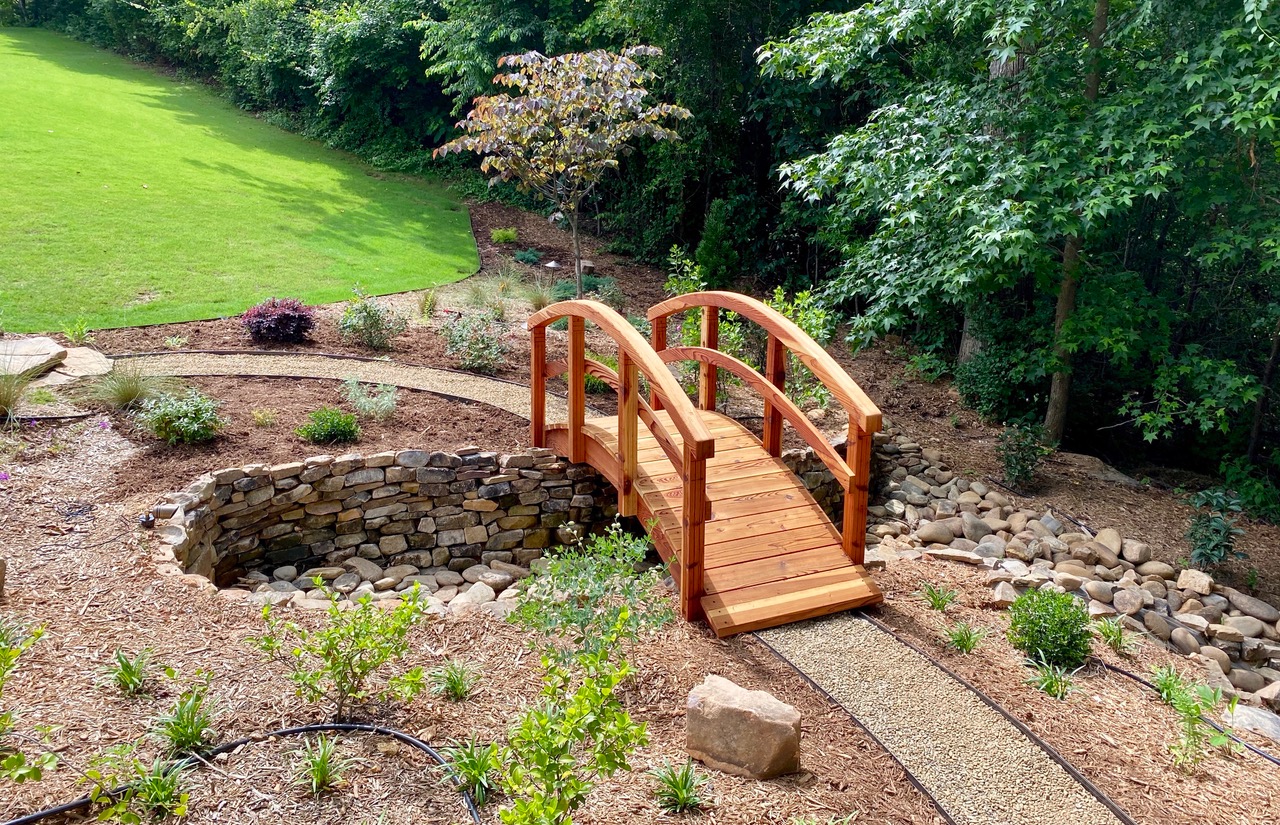
Dry creek beds are another landscape feature that can work well with wooden garden bridges.
A properly designed bridge can provide a defined crossing over a decorative stone channel or landscaped depression.
For homeowners considering this arrangement, the height and shape of the bridge become especially important.
An arched structure can create additional visual separation between the walking surface and the landscape below.
Any functional drainage channel must retain adequate flow capacity, and the bridge supports should be appropriate for the actual ground conditions.
Garden Ponds and Water Features
An arched wooden bridge may also be incorporated into a garden containing a pond or ornamental water feature.
The curved silhouette can become an attractive visual element above the water, particularly when viewed from surrounding paths or seating areas.
The bridge must be properly sized and supported for the intended crossing, with careful attention to moisture exposure and applicable safety requirements.
The Baldwin City project illustrates the appeal of a custom arched design, although its specifications do not establish that it was installed over a pond or stream.
Garden Design in Baldwin City's Changing Seasons
A landscape feature that looks attractive in midsummer should also complement the garden throughout the rest of the year.
Baldwin City experiences distinct seasonal changes, and those changes affect the appearance and maintenance needs of outdoor wooden structures.
Spring Gardens
During spring, fresh foliage, flowering shrubs, and emerging perennials create a colorful backdrop for natural redwood.
A wooden bridge can become a focal point along a garden path or between planted areas.
Spring rainfall also makes good drainage important, particularly around bridge supports and low-lying parts of the landscape.
Summer Landscapes
During the warmer months, the rich tones of redwood contrast attractively with green lawns, shade trees, and dense ornamental planting.
A garden bridge can provide a visual destination within a backyard, encouraging movement from one part of the outdoor space to another.
Prolonged sunlight can affect wood finishes, making regular visual inspections worthwhile.
Autumn Colors
Autumn brings a different character to gardens in northeastern Kansas.
Changing leaves, golden grasses, and warm seasonal colors complement the natural appearance of a redwood structure.
An arched bridge can remain a prominent landscape feature after summer flowers have faded.
Removing fallen leaves from the walking surface helps prevent moisture accumulation and slippery conditions.
Winter Conditions
Winter introduces freezing temperatures, occasional snow, and ice.
Wooden bridges should be checked for slippery surfaces and weather-related changes before use.
Appropriate care during winter helps protect both the bridge and its protective finish.
Custom-Built Versus Standard Wooden Garden Bridges
Standard wooden bridges can be an attractive option when their dimensions and design match the needs of a property.
However, not every landscape or homeowner's vision fits a standard configuration.
The Baldwin City project demonstrates several advantages of commissioning a custom-built structure.
Dimensions Selected for the Project
The customer specified a bridge measuring 12 feet long and 3 feet 8 inches wide.
Choosing the dimensions as part of the custom design allowed the project to reflect the desired proportions rather than simply relying on a predetermined size.
A Personalized Arch Height
The eight-inch arch was requested specifically to create a higher bridge profile with additional ground clearance.
This level of customization allows homeowners to give greater consideration to both the shape of the bridge and the characteristics of the intended installation area.
Individual Railing Arrangements
The four-post arrangement on each side was another customer-driven feature.
Rather than accepting the number of posts in a standard design, the homeowner requested a particular configuration that influenced the appearance of the finished bridge.
Unique Woodworking Features
The laminated handrail is an especially clear example of the benefits of custom construction.
The customer wanted three rail pieces joined to make a wider upper handrail and placed above the posts.
This was a specific design requirement that went beyond simply changing the size of an existing bridge.
A Bridge With Its Own Character
When dimensions, arch height, rail configuration, and finishing details are selected together, the result becomes an individual project rather than a conventional garden accessory.
That individuality was central to the homeowner's vision for the Baldwin City bridge.
Choosing the Right Size for a Backyard Redwood Bridge
Homeowners planning a similar project should begin by considering the bridge's location, intended purpose, and relationship to the surrounding landscape.
The length and width should be appropriate for the space, but several other measurements also deserve attention.
Bridge Length and Support Locations
The overall length of a bridge is not necessarily the same as the unsupported distance it can safely span.
A 12-foot bridge requires suitable support conditions, and the permissible clear span depends on the structural design.
Before selecting a bridge, the installation area should be measured carefully, including the locations where the ends will rest.
Bridge Width and Walking Space
Width affects both appearance and usability.
The Baldwin City customer selected a 44-inch-wide bridge, creating a broader overall structure than many narrow decorative garden bridges.
When considering a similar design, homeowners should distinguish between the bridge's overall width and the usable walking area between any railings or posts.
The intended use, approach paths, and accessibility needs should all influence the choice of width.
Arch Height and Walking Surface
Arched bridges introduce changes in elevation along the walking surface.
While the curve contributes to their appearance, it is important to consider how the bridge will be approached and crossed.
Garden pathways should connect appropriately with the ends of the bridge, avoiding unnecessary abrupt changes in level.
Railing Height and Configuration
Railing dimensions influence the appearance of the structure, but they may also be subject to safety and building requirements depending on the installation.
The 30-inch top railing height used for this particular project was one of the customer's specifications.
Other bridges may require different railing arrangements based on their location, purpose, fall exposure, and applicable regulations.
Maintaining a Redwood Garden Bridge in Baldwin City, Kansas
Proper maintenance is an important part of owning any outdoor wooden bridge.
Even naturally durable wood can experience weathering, surface wear, and changes caused by moisture and temperature.
For homeowners in Baldwin City and surrounding communities, a practical maintenance routine can help preserve the appearance and condition of a redwood bridge.
Keep the Walking Surface Clean
Leaves, soil, and other debris should be removed regularly.
Organic material left on the bridge can trap moisture and create slippery conditions, particularly in shaded areas.
Inspect Railings and Connections
Periodically check railing posts, handrails, decking, and visible connections for signs of damage, loosening, or deterioration.
Any significant structural concern should be evaluated before the bridge is used again.
Monitor the Protective Finish
Sealed redwood should be inspected for areas where the finish is wearing, peeling, or no longer providing the intended protection.
Reapplication schedules vary depending on the coating, weather exposure, and wear.
Maintain Drainage Around the Bridge
Water should not be allowed to collect unnecessarily around wooden supports or remain trapped against structural components.
Keeping soil, mulch, and vegetation from accumulating against the bridge can help reduce prolonged moisture exposure.
Check the Bridge After Severe Weather
Heavy rainfall, strong winds, falling branches, or ground movement may affect outdoor structures.
A visual inspection after significant weather events can help identify potential problems before they become more serious.
What Makes This Baldwin City Redwood Bridge Special?
The defining quality of this project is not one individual measurement or decorative element. It is the way several personalized details were combined into one cohesive bridge design.
The homeowner wanted a structure that reflected specific preferences, and those requests shaped the entire project.
- A 12-foot length: The bridge was built to the requested overall dimensions.
- A 44-inch width: The custom width established the desired proportions.
- An 8-inch high arch: The raised curve was selected to provide additional ground clearance and a more pronounced profile.
- Eight railing posts: Four posts on each side created the requested railing arrangement.
- A wider laminated handrail: Three redwood rail pieces were joined together to form the distinctive top handrail.
- Top-mounted handrail placement: The wide handrail was positioned above the posts.
- A flush center rail: The middle railing was aligned with the posts for the desired appearance.
- A 30-inch railing height: The top rail was positioned at the customer's specified height above the walking surface.
- A sealed finish: The natural redwood received a protective finish.
Individually, each of these features changes some aspect of the bridge. Together, they create a structure with a clear identity and a design that reflects the homeowner's personal vision.
Frequently Asked Questions About Custom Redwood Garden Bridges in Baldwin City
Can a 12-foot redwood garden bridge be custom-built?
Yes. A 12-foot redwood garden bridge can be built with customized dimensions, arch profiles, railing arrangements, and finishing details. The Baldwin City project measures 12 feet long and 3 feet 8 inches wide, with several additional design features requested by the homeowner.
What is the purpose of an 8-inch arch on a wooden garden bridge?
An 8-inch arch creates a curved profile and can help provide additional space beneath the center of a bridge compared with a flatter configuration. Actual ground clearance depends on the bridge structure and installation conditions. The Baldwin City homeowner specifically requested this arch height to increase clearance.
Why use a laminated redwood handrail?
Laminating multiple pieces of redwood allows a custom handrail profile to be created. For this project, three rail components were glued together to make a wider upper handrail, which was then positioned on top of the posts.
How many railing posts does this bridge have?
The custom Baldwin City bridge has eight railing posts in total, with four posts on each side. The customer requested this arrangement as part of the bridge's personalized design.
How high are the railings on this custom bridge?
The top railing was designed to sit 30 inches above the walking surface. This was a project-specific requirement and should not be interpreted as a universal railing standard for all pedestrian bridges.
Is redwood a suitable material for outdoor bridges in Kansas?
Redwood is a popular choice for outdoor woodworking because of its natural appearance, dimensional stability, and the decay resistance associated with its heartwood. Appropriate construction, suitable supports, protective finishing, and ongoing maintenance are important for outdoor performance in Kansas.
Does a sealed redwood bridge require maintenance?
Yes. Exterior wood finishes gradually wear through exposure to sunlight, moisture, and foot traffic. Cleaning, periodic inspections, and refinishing when necessary can help maintain the bridge's appearance and condition.
Can a redwood bridge be used over a dry creek bed?
A properly designed redwood bridge can be considered for a decorative dry creek bed, landscaped depression, or similar garden crossing. The appropriate dimensions, structural supports, drainage conditions, and intended loading must be evaluated for the specific site.
Can the number of railing posts be customized?
Yes. Railing arrangements can be developed around the customer's design preferences and the structural requirements of the bridge. The Baldwin City customer requested four posts on each side to achieve a particular appearance.
Can a custom bridge have a wider walking surface?
Yes. Custom construction allows bridge width to be considered alongside length, arch height, and railing configuration. The Baldwin City project has an overall width of 44 inches. The appropriate size for another property depends on the installation location and intended use.
Are custom redwood bridges suitable for rural Kansas properties?
Custom redwood bridges can complement a variety of rural and residential landscapes, including woodland gardens, prairie-inspired plantings, landscaped pathways, and decorative water features. The design and structural requirements should always reflect the conditions at the actual installation site.
Can homeowners in Lawrence, Eudora, or Ottawa order a similar custom garden bridge?
Yes. Homeowners in Baldwin City, Lawrence, Eudora, Ottawa, and other Kansas communities can explore custom redwood bridge designs with personalized dimensions and features. Each project can be considered according to its intended setting and the customer's requirements.
Custom Redwood Garden Bridges for Baldwin City and Douglas County, Kansas
Baldwin City is only one of the many communities where a handcrafted wooden bridge can complement a residential landscape.
Throughout Douglas County and neighboring areas of northeastern Kansas, homeowners have opportunities to create outdoor spaces that reflect the natural character of the region.
In Lawrence, a redwood bridge might become part of an established backyard garden with mature trees and perennial planting beds. In Eudora, a curved wooden bridge could complement a landscape pathway or decorative stone feature. Around Ottawa and the surrounding countryside, larger residential properties may provide opportunities for bridges incorporated into more expansive outdoor settings.
These are examples of possible landscape designs rather than descriptions of the Baldwin City customer's installation.
The important consideration is that a bridge should fit both the physical landscape and the homeowner's vision.
Some properties call for a simple, understated design. Others benefit from a more prominent high-arched bridge with decorative railings and custom woodworking details.
The Baldwin City project shows how a customer can move beyond standard dimensions to create something with a more personal character.
From a Customer's Vision to a Handcrafted Redwood Bridge
Every custom bridge project begins with an idea. Sometimes that idea is a particular shape or dimension. In other cases, the homeowner has a detailed picture of how the finished structure should look.
Our Baldwin City customer knew exactly which details were important.
The bridge needed to measure 12 feet long and 3 feet 8 inches wide. It needed a higher eight-inch arch for additional ground clearance. Each side needed four railing posts, and the middle railing had to sit flush with those posts.
Most distinctively, the upper handrail had to be made from three laminated redwood rail pieces, producing a wider profile positioned directly above the posts.
The top railing was specified at 30 inches above the walking surface, and the completed redwood bridge received a sealed finish.
These requirements were not simply changes to the appearance of a standard model. They were the foundation of a genuinely custom project.
The completed design brings together a graceful curved profile, substantial railings, natural redwood, and the specific woodworking details the homeowner wanted.
For us, this is one of the most enjoyable aspects of building custom bridges: helping customers turn their individual ideas into a real wooden structure.
Not every homeowner wants the same bridge, and not every garden calls for the same design. Some customers prioritize a particular span or width. Others are especially interested in decorative railings, a pronounced arch, or a specific handrail profile.
The Baldwin City project reflects that individuality. It is a bridge designed around a customer's vision, with the dimensions and details selected to create a distinctive result.
Bring Your Own Custom Redwood Garden Bridge to Life
A thoughtfully designed wooden bridge can become one of the most memorable features of an outdoor landscape. Whether it crosses a decorative garden feature, connects pathways, or serves as an architectural focal point, its shape, materials, and proportions all contribute to the character of the surrounding space.
The custom 12-foot redwood bridge built for Baldwin City, Kansas 66006, demonstrates the possibilities of personalized bridge construction. Its 8-inch arch, eight-post railing arrangement, flush center rail, laminated three-piece top handrail, and sealed redwood finish were all selected to reflect one homeowner's individual preferences.
At Redwood Garden Bridges, we enjoy creating handcrafted wooden bridges for customers who have something special in mind. From traditional arched designs to projects with distinctive dimensions and custom railing details, every bridge offers an opportunity to bring a personal vision to life.
If you are considering a custom wooden bridge for your backyard, landscaped property, garden path, or decorative crossing, explore our handcrafted garden bridges and discover how a personalized design can complement your outdoor space.
Your garden is unique. Your bridge can be, too.
- Bridge Articles
- Wooden Garden Bridges - What to Consider
- curved double-rail garden bridge
- Low-Profile Redwood Garden Bridge
- Best Garden Bridges Gallery
- Japanese Zen Garden Bridges
- Routered Heavy Duty Handrails
- Natural Redwood Walkway Footbridge no post
- SunBurst Spindles Bridges
- High Arch Garden Bridges
- Half Spindle Garden Bridges
- Picket & Spindle Garden Bridges
- Zen Moon Garden Bridges
- 3D Videos Garden Bridges
- Asian-Zen-Inspired Garden Bridges
- Pedestrian Trail Wooden Bridges
- Top Rated Garden Bridges
- 40 ft High Quality Garden Bridges
- Traditional Zen Japanese Garden Bridge
- Swimming Pool Bridges Steps
- Handcrafted Trex Composite Garden Bridges
- Large Wooden Garden Bridges
- Country-Style Redwood Garden Bridge
- Wheelchair Ramps
- Heavy-Duty-Tractor- Bridges
- Torii Gate
- Horse Trail Bridges
- Wedding Garden Bridges
- Post Caps Garden Bridges
- Garden Bridge Accessories
- Water Garden Links
- Garden bridge plans
- Koi for Sale
- Redwood Characteristics
- Fish-safe Wooden pond bridges
- Our Vision and Mission Statement
- Garden Bridges Testimonials 1
- Garden Bridges Testimonials 2
- Tractor Bridges
- Monet Bridges
- Asian Style Zen Gardden Bridges
- Articles 2017
- Articles 2018
- Articels 2021
- About Your Bridge Order